

While most creditors are restricted by law to a 25% cap, the IRS can legally garnish 70% or more of your take-home pay, often leaving a single individual with as little as $309.62 per week for all expenses. You've likely felt a deep sense of unease seeing a formal notice or seeking IRS wage garnishment help after worrying about how your employer perceives the situation. It's a stressful experience that threatens both your financial stability and your professional reputation.
This guide provides the methodical steps you need to understand your rights and secure a levy release. We'll explore how professional transcript analysis and Enrolled Agent strategies can help you establish a sustainable payment plan or settlement. By following a clear, structured path, you can resolve these federal tax issues and restore your long-term peace of mind. Our goal is to provide the steady, professional support required to navigate these complex IRS letters with confidence.
Key Takeaways
- Gain clarity on the specific notification sequence the IRS must follow before initiating a levy, helping you identify the critical deadlines for action.
- Discover how professional IRS wage garnishment help can facilitate the release of an active levy through hardship claims or formal payment arrangements.
- Learn why an Enrolled Agent serves as an essential buffer, managing complex IRS communications to protect your privacy and professional standing with your employer.
- Understand how transcript analysis can uncover errors in your tax record, providing a methodical foundation for a sustainable and accurate resolution.
Understanding the IRS Wage Garnishment Process and Your Rights
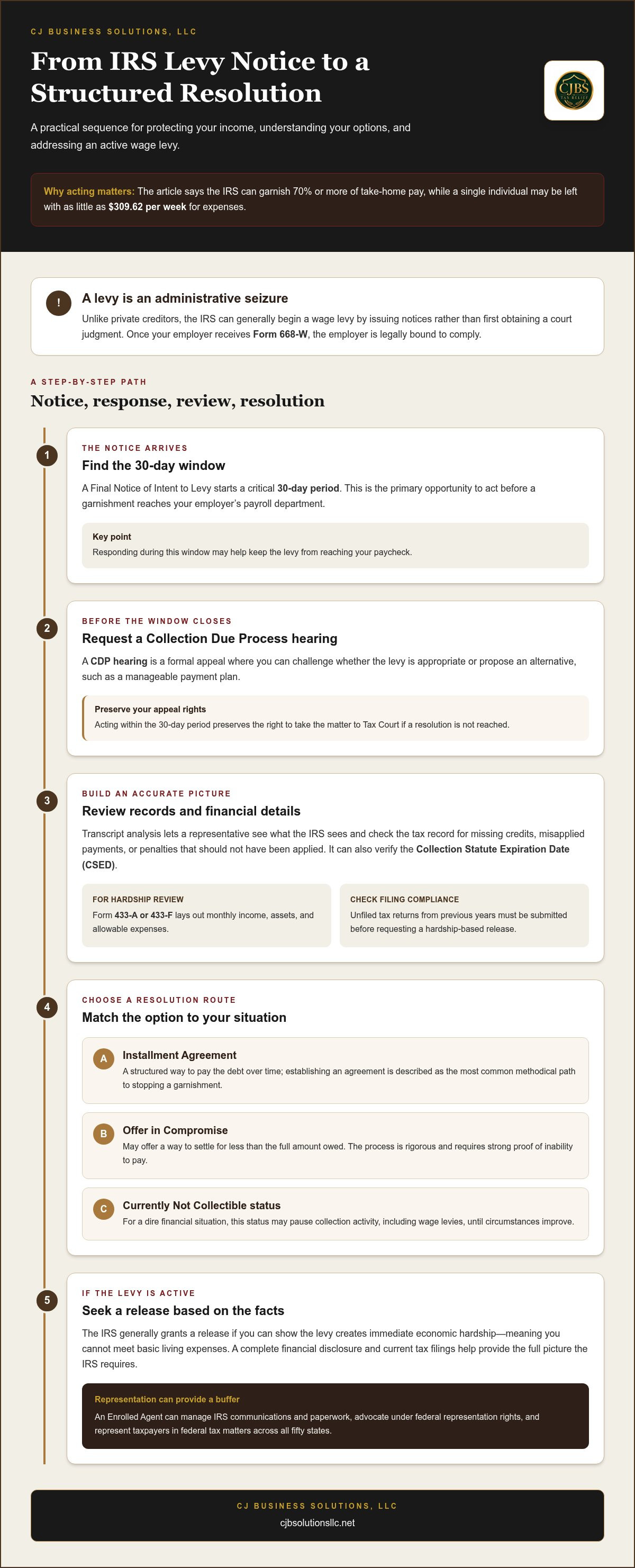
A wage garnishment, technically known as a levy, represents a legal seizure of your income to satisfy an outstanding tax debt. While private creditors must typically secure a court judgment before touching your paycheck, the IRS possesses the unique authority to bypass this step. By simply issuing a series of notices, the agency can begin diverting a significant portion of your earnings. Understanding a Tax Levy is the first step in realizing that this process is administrative rather than judicial. Once your employer receives Form 668-W, they're legally bound to comply with the order. This often creates a sense of vulnerability, as your private tax matters suddenly involve your professional workplace. Seeking professional IRS wage garnishment help during this phase is vital to ensure you don't lose the majority of your net pay to a continuous levy.
The 30-Day Window: Your Opportunity for Prevention
The IRS doesn't seize funds without warning. You'll receive a Final Notice of Intent to Levy, which initiates a critical 30-day window. This period is your primary chance to prevent the garnishment from ever reaching your employer's payroll department. It's a time for calm, methodical action rather than panic. One of your most powerful rights during this time is requesting a Collection Due Process (CDP) hearing. This formal appeal allows you to challenge the levy's appropriateness or propose alternative solutions, such as a manageable payment plan. Acting within these thirty days preserves your right to take the matter to Tax Court if a resolution isn't reached, providing a structured way to protect your financial stability before the seizure begins. Taking these steps early, often with professional IRS wage garnishment help, ensures that your income remains under your control while you work toward a long-term solution.
Effective Strategies to Stop or Release an Active Wage Levy
When a levy is already impacting your paycheck, the focus shifts toward securing an immediate release. The IRS generally grants a release if you can demonstrate that the seizure creates an immediate economic hardship, meaning you can't meet basic living expenses. While Federal Wage Garnishment Laws provide a baseline of protection for most workers, the IRS's unique authority often requires a more proactive approach to stop the flow of funds. Establishing an Installment Agreement is the most common methodical path to stopping a garnishment. It provides a structured, predictable way to satisfy your debt while ending the continuous seizure of your earnings. This process is often the first step in regaining financial stability.
For taxpayers facing significant debt, an Offer in Compromise may offer a path to settle for less than the full amount owed. This process is rigorous and requires a high standard of proof regarding your inability to pay. Alternatively, if your financial situation is currently dire, you might qualify for "Currently Not Collectible" status. This designation pauses collection activity, including wage levies, until your financial circumstances improve. If you find the complexity of these programs daunting, seeking professional IRS wage garnishment help can provide the steady guidance needed to choose the right resolution strategy.
Hardship Claims and Financial Disclosure
To secure a release based on hardship, you'll need to provide a transparent view of your finances using Form 433-A or 433-F. These documents detail your monthly income, assets, and allowable expenses according to IRS standards. It's vital to ensure you're "current and compliant" before requesting a release. This means all unfiled tax returns from previous years must be submitted to the agency. A methodical approach to these disclosures often leads to a quicker resolution, as the IRS requires a complete picture before they'll agree to stop a levy. Ensuring your filings are up to date is a non-negotiable step in restoring your financial peace of mind.
How Professional Representation and Transcript Analysis Create a Solution
Seeking professional IRS wage garnishment help often provides more than just a temporary pause on collections; it offers a comprehensive path toward total resolution. An Enrolled Agent (EA) acts as a dedicated buffer between you and the taxing authority, managing all communications so you don't have to face the agency alone. These professionals carry federal representation rights, allowing them to advocate for you regardless of your location. This level of representation ensures that your rights are protected throughout the negotiation process. By handling the complex paperwork and direct dialogues with IRS agents, a professional firm allows you to maintain your focus on your daily life and career.
A cornerstone of a professional defense is the thorough review of your official tax records. Transcript analysis allows a representative to "see what the IRS sees," which is crucial for identifying errors in the original tax assessment. It's common to find missing credits, misapplied payments, or penalties that shouldn't have been applied. Additionally, a strategic defense includes verifying the Collection Statute Expiration Date (CSED). If the legal timeframe for collection has passed, the levy is no longer lawful. This methodical investigation ensures that any resolution is based on accurate data rather than just the initial numbers provided by the agency.
The Enrolled Agent Advantage in Tax Resolution
The federal authorization of Enrolled Agents means they're uniquely qualified to handle federal tax matters across all fifty states. This national scope is particularly beneficial for complex cases that require a deep understanding of federal code. Beyond simple representation, the process of transcript decoding is where the most value is often found. By meticulously reviewing your history, an EA can pinpoint specific discrepancies that might lead to a reduced tax liability. This level of precision transforms a stressful situation into a manageable, data-driven plan for resolution, providing you with a reliable guide through the collection storm.
Securing Your Financial Future Through Professional Advocacy
Restoring your financial stability after a levy begins with a clear understanding of your rights and the methodical steps required for a release. We've explored how identifying the critical 30-day window and utilizing expert transcript analysis can uncover errors that the IRS might've overlooked. These strategies ensure that any resolution is based on accurate data rather than just the initial assessment. It's a path forward. When you're seeking IRS wage garnishment help, having a steady, reliable partner makes a significant difference in navigating complex federal tax issues. Our firm provides national tax resolution services led by a professional Enrolled Agent who acts as your dedicated buffer. We invite you to consult with an Enrolled Agent at CJ Business Solutions, LLC to resolve your wage levy and begin transcript analysis. With the right guidance, you can move toward long-term tax compliance and lasting peace of mind.
Common Questions Regarding IRS Wage Levies
How much of my paycheck can the IRS legally take?
The IRS calculates the amount it leaves you rather than the amount it takes. According to Publication 1494 for 2026, a single individual with no dependents who is paid bi-weekly is only allowed to keep $619.23 from their paycheck. This often results in the agency seizing 50% to 70% of your net income. If you have a second job, the IRS can garnish 100% of that secondary income.
Can my employer fire me for having an IRS wage garnishment?
Under federal law, your employer cannot terminate your employment simply because your wages are being garnished for a single debt. This protection is designed to ensure that seeking IRS wage garnishment help doesn't lead to job loss. It's important to remember that this legal shield might not apply if you have multiple garnishments from different creditors. Maintaining open, professional communication with your payroll department is usually the best approach.
How long does it take for a wage levy to be released once I reach an agreement?
Once you reach a formal resolution, the IRS typically issues a release notice, Form 668-D, to your employer. While the agency can occasionally fax this release immediately, it often takes several business days for your payroll department to process the change. You should monitor your next pay cycle closely to ensure the deduction has stopped. A professional representative can help expedite this communication to ensure your full income is restored quickly.
What is the difference between a wage garnishment and a bank levy?
A wage garnishment is a continuous levy that remains in effect for every pay period until the debt is satisfied or released. In contrast, a bank levy is a one-time seizure of the specific funds available in your account at the moment the bank receives the notice. While a bank levy doesn't affect future deposits, a wage garnishment requires active IRS wage garnishment help to stop the recurring deductions from your earnings.

Article by
Crystal R. Johnson, MBA EA
Crystal Johnson founded CJ Business Solutions to give individuals and small-business owners something often missing from the tax and accounting process: clear explanations, practical solutions, and trusted support.
With more than 27 years of accounting and financial experience, Crystal helps clients understand complicated tax matters, restore compliance, respond to IRS concerns, and make stronger business decisions. As an Enrolled Agent, she is federally authorized to represent taxpayers before the Internal Revenue Service.


