

Did you know that the IRS can add a 5% monthly penalty to your balance for every month a return remains missing? If you've been receiving collection notices or feel paralyzed by the Substitute for Return process, you aren't alone. Seeking an unfiled tax returns penalty abatement is a practical way to address this anxiety and stop the cycle of compounding interest. We understand that life presents challenges that make tax compliance difficult, and we believe you deserve a professional, steady path forward.
This article will show you how to navigate IRS relief to potentially reduce or eliminate these heavy financial burdens. You'll learn about the new 2026 Automatic Exemption from Penalty program and how transcript analysis can uncover relief opportunities. We'll provide a methodical overview of how to restore your standing with the IRS and protect your assets from aggressive collections. By understanding your options, you can replace confusion with a clear strategy for compliance.
Key Takeaways
- Understand how the 5% monthly failure-to-file penalty is calculated and why the Substitute for Return process often leads to an inflated tax balance.
- Explore the specific eligibility requirements for an unfiled tax returns penalty abatement, including the transition to the new Automatic Exemption from Penalty program in 2026.
- Learn how specialized transcript analysis serves as a methodical diagnostic tool to identify errors and build a compelling case for relief.
- Discover the advantages of professional representation to navigate complex IRS negotiations with confidence and establish a clear, reliable path to compliance.
The True Cost of Unfiled Tax Returns and the Path to Abatement
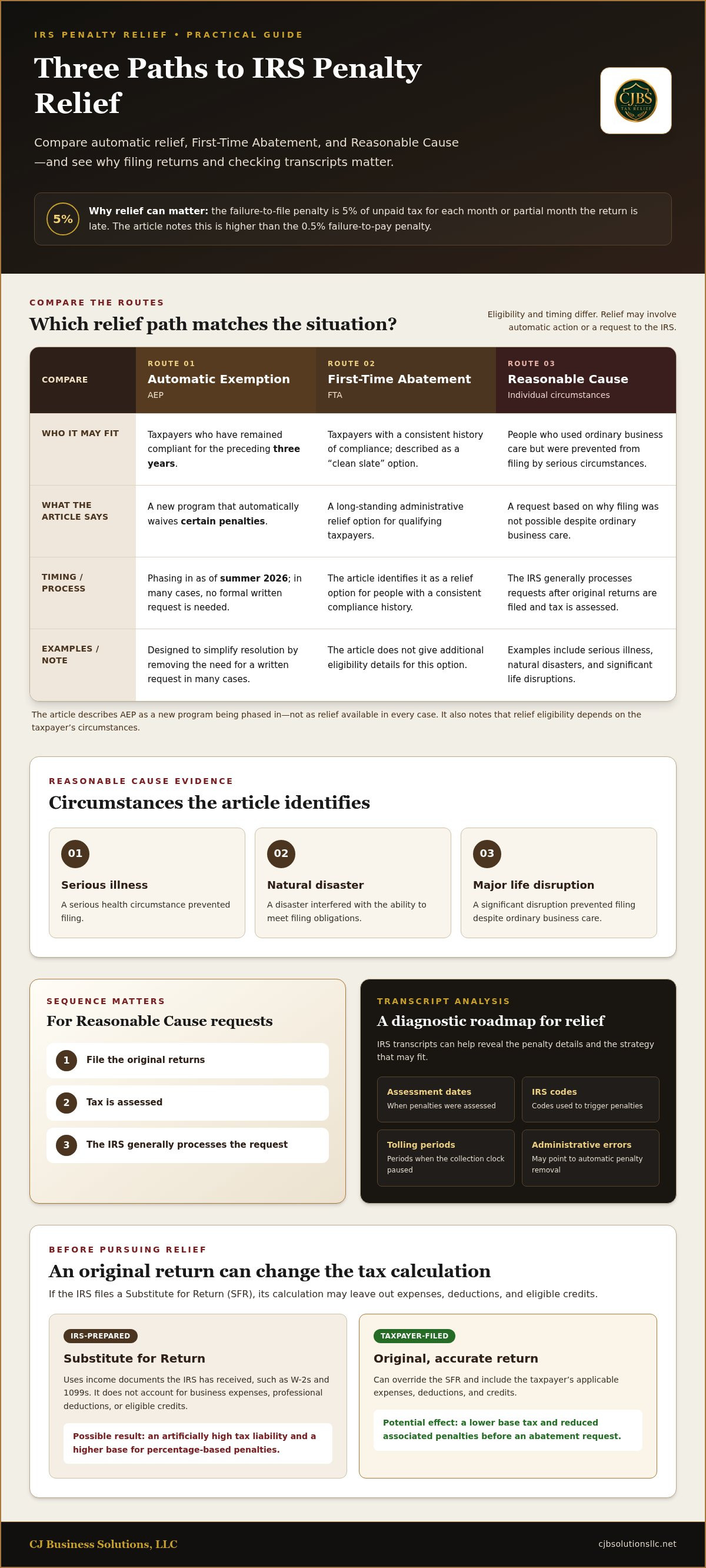
When a tax deadline passes without a filing, the financial consequences begin to mount almost immediately. The IRS applies a failure-to-file penalty of 5% of the unpaid tax for each month or partial month the return is late. This specific charge is significantly larger than the 0.5% failure-to-pay penalty, making it the most aggressive addition to your debt. For returns required to be filed in 2026, the minimum penalty for being over 60 days late is the lesser of $525 or 100% of the unpaid tax. For those seeking an unfiled tax returns penalty abatement, it's helpful to view this relief as an act of administrative grace. These programs exist to encourage voluntary compliance, allowing taxpayers to request a waiver if they can demonstrate a valid reason for the delay.
If several years pass without action, the IRS may initiate a "Substitute for Return" (SFR). This is a formal process where the agency prepares a return on your behalf to assess tax. It's useful to consult resources on IRS penalties for late filing to see how these automated assessments can quickly spiral. This process is essentially the IRS's way of forcing the conversation, but it's a conversation that starts with a balance that is often much higher than necessary.
Substitute for Return: Why the IRS's Version Costs You More
When the IRS creates an SFR, they rely solely on income documents they've already received, such as W-2s and 1099s. They don't account for your business expenses, professional deductions, or eligible credits. This results in an artificially high tax liability. Because penalties are calculated as a percentage of that tax, the SFR inflates your total debt. By filing an original, accurate return to override the SFR, you can lower the base tax. This naturally reduces the associated penalties before you even begin the formal process of an unfiled tax returns penalty abatement.
Proven Strategies for IRS Penalty Abatement and Relief
Seeking relief requires a clear understanding of IRS administrative policies. For those with a consistent history of compliance, the First-Time Abatement (FTA) has long served as a "clean slate" option. However, as of summer 2026, the IRS is phasing in a new automatic penalty relief process known as the Automatic Exemption from Penalty (AEP). This program automatically waives certain penalties for taxpayers who have remained compliant for the preceding three years. It simplifies the path to resolution by removing the need for a formal written request in many cases.
If you don't qualify for automatic relief, you may still pursue an unfiled tax returns penalty abatement through "Reasonable Cause." This criteria applies if you exercised ordinary business care but were prevented from filing due to serious illness, natural disasters, or significant life disruptions. It's essential to remember that the IRS generally processes these requests only after your original returns are filed and the tax is assessed. This sequence ensures the agency has a final balance to which the abatement can be applied.
The Power of Transcript Analysis in Your Defense
A professional review of your IRS transcripts is the most reliable way to build a defense. These records identify the exact date penalties were assessed and the specific codes the IRS used to trigger them. Transcript data often reveals "tolling" periods where the collection clock was paused or highlights administrative errors that could lead to automatic penalty removal. Our transcript analysis services provide the diagnostic clarity needed to determine which years are eligible for relief and which strategy offers the best outcome. Transcript analysis serves as the diagnostic roadmap for any successful tax resolution strategy.
Navigating the Abatement Process with Professional Representation
Handling the IRS requires a methodical approach that goes beyond simply filling out forms. An Enrolled Agent is uniquely qualified to manage an unfiled tax returns penalty abatement because they hold federal authorization to represent taxpayers directly before the agency. Instead of the stress of receiving collection notices, you can rely on a professional to manage all correspondence and phone calls. This transition allows you to focus on your daily life while your representative builds a compelling defense based on "Reasonable Cause" evidence. This process involves gathering records like medical statements or disaster declarations to prove you acted with ordinary prudence despite your circumstances.
The recent shift toward automation has been a significant development for many. As noted by the Taxpayer Advocate on penalty relief, these changes aim to make the system more equitable for those trying to do the right thing. However, professional guidance remains vital for navigating the nuances that automation might miss. Beyond immediate relief, a professional establishes a long-term compliance plan. This ensures you avoid future penalties and maintain a clear path toward financial stability.
The Enrolled Agent Advantage: Your Seasoned Mentor
Choosing an Enrolled Agent means partnering with a specialist who understands the IRS's internal logic. Our approach follows a "soft-touch" methodology, prioritizing logical progression and expert communication over aggressive confrontation. This federal authorization allows us to represent clients in all 50 states, providing a consistent standard of care regardless of your location. We encourage you to view an unfiled tax returns penalty abatement as a collaborative recovery process. It isn't just a transactional service; it's a way to restore your peace of mind through the guidance of a seasoned mentor who speaks the IRS's language fluently.
Restoring Your Peace of Mind and Financial Stability
Resolving missing tax years is a methodical process that begins with understanding the true cost of inaction. By overriding an IRS Substitute for Return and pursuing an unfiled tax returns penalty abatement, you can effectively reduce an inflated balance to its proper level. Whether you qualify for the new automatic relief program or require a defense based on reasonable cause, success depends on having a clear diagnostic roadmap. Taking this first step allows you to replace the stress of collection notices with a structured plan for recovery.
Our team, led by an authorized Enrolled Agent, provides national tax resolution expertise to guide you through these complexities. We invite you to schedule a professional transcript analysis with CJ Business Solutions, LLC to start your path to tax relief. This specialized service identifies errors and builds a strategy tailored to your history. You don't have to face the IRS alone; a steady partner is available to help you reclaim your financial future.
Frequently Asked Questions
What is the IRS First-Time Penalty Abatement (FTA) program?
The FTA program is an administrative waiver for taxpayers with a three-year clean compliance history. Starting in the summer of 2026, the IRS is phasing in the Automatic Exemption from Penalty (AEP) program to replace it. This update automatically waives failure-to-file and failure-to-pay penalties for eligible individuals, removing the need for a formal request for those who have remained compliant in recent years.
Can I request penalty abatement if I haven't filed my returns yet?
You generally cannot request an unfiled tax returns penalty abatement until your missing returns are filed and the IRS assesses the tax liability. The agency must determine the final balance before they can calculate and waive the associated penalties. Filing your original, accurate returns is the essential first step to establishing your eligibility for relief and stopping the accumulation of further failure-to-file charges.
What qualifies as 'Reasonable Cause' for not filing tax returns?
Reasonable cause applies when you demonstrate that you exercised ordinary business care but were unable to meet your obligations due to circumstances beyond your control. The IRS typically accepts reasons such as natural disasters, house fires, or the death of an immediate family member. Serious illness or an inability to obtain records despite a high standard of effort may also qualify you for this relief.
How much can the IRS charge in penalties for unfiled returns?
The failure-to-file penalty is 5% of the unpaid tax for each month a return remains late, reaching a maximum of 25%. For returns required in 2026 that are over 60 days late, the minimum penalty is the lesser of $525 or 100% of the unpaid tax. These costs are compounded by a failure-to-pay penalty and daily interest, which can significantly increase your total balance.
What happens if the IRS already filed a Substitute for Return for me?
When the IRS files an SFR, they assess your tax using only reported income without accounting for your deductions or credits. You should file an original return to override this assessment and establish a correct, lower tax liability. This step is a vital component of an unfiled tax returns penalty abatement strategy, as reducing the base tax naturally lowers the penalties calculated from it.
How long does the IRS penalty abatement process take?
The IRS typically takes between 60 and 120 days to process a penalty abatement request once it is received. It's helpful to remember that this timeline only begins after your unfiled returns have been fully processed and the tax has been assessed. A professional representative can monitor your account transcripts to ensure your request moves through the system at a steady, methodical pace toward resolution.

Article by
Crystal R. Johnson, MBA EA
Crystal Johnson founded CJ Business Solutions to give individuals and small-business owners something often missing from the tax and accounting process: clear explanations, practical solutions, and trusted support.
With more than 27 years of accounting and financial experience, Crystal helps clients understand complicated tax matters, restore compliance, respond to IRS concerns, and make stronger business decisions. As an Enrolled Agent, she is federally authorized to represent taxpayers before the Internal Revenue Service.


