

Did you know that approximately one million taxpayers qualify for IRS penalty relief every year but never actually receive it because they don't know how to ask? It's understandable to feel overwhelmed when you open a notice and see that interest and penalties have caused your original balance to skyrocket. The fear of wage garnishment or a bank levy can make it difficult to focus on a solution. Fortunately, securing professional tax penalty abatement help can transform this situation by identifying specific legal paths to lower your total liability.
This guide will explain the exact steps to qualify for and request relief, including a look at the new 2026 Automatic Exemption from Penalty program. You'll learn how specialized transcript analysis can uncover hidden opportunities to remove administrative penalties and reduce associated interest. We'll provide a clear roadmap to help you regain financial compliance and the peace of mind that comes from having a seasoned mentor handle the complexities of the IRS on your behalf. By understanding your options, you can move forward with confidence and a strategy that prioritizes your long-term stability.
Key Takeaways
- Explore the transition to the Automatic Exemption from Penalty (AEP) program and how your filing history determines your eligibility for immediate relief.
- Identify the documentation needed to prove "Reasonable Cause," ensuring the IRS understands the specific circumstances that prevented timely compliance.
- Learn why performing a detailed transcript analysis is a necessary first step in securing professional tax penalty abatement help to lower your overall debt.
- Understand the strategic options available through the IRS Appeals process should your initial request for penalty removal require further review.
Understanding IRS Penalties and the Path to Abatement
Facing the IRS can feel like a heavy burden, especially when you realize that the balance you owe isn't just the original tax amount. Tax penalty abatement is the formal process of removing or reducing these additional assessments. These charges often stem from specific triggers like Failure to File (FTF), Failure to Pay (FTP), or Failure to Deposit (FTD). While Understanding IRS Penalties is the first step toward resolution, remember that abatement specifically targets the penalties themselves, not the underlying tax debt. While the interest itself cannot be abated directly, it will decrease automatically if the underlying penalty is removed. If you're seeking tax penalty abatement help, starting with a clear view of your account status is essential.
Why the IRS Grants Penalty Relief
The IRS actually prefers voluntary compliance over punitive measures. They understand that life events can sometimes interfere with your ability to meet tax obligations. Because of this, administrative waivers are available for those with a history of being responsible. By offering these relief paths, the government encourages taxpayers to return to the system and stay current with future filings. This approach helps maintain a cooperative relationship between the taxpayer and the agency, acknowledging that a clean compliance history deserves a second chance.
The Financial Impact of Compounding Penalties
Left unaddressed, penalties and interest can cause a manageable debt to double in a surprisingly short time. For example, the Failure to File penalty can reach 25% of the unpaid tax within just five months. When combined with quarterly interest rates that hover around 6% to 7% for 2026, the total grows daily. Addressing these penalties early stops the cycle of compounding debt and serves as a vital first step in a broader strategy for long-term financial health. It's about more than just the immediate savings; it's about clearing the path toward total resolution.
Criteria for Qualifying for Tax Penalty Relief
Understanding the specific standards the IRS uses to evaluate requests is a crucial step for anyone seeking tax penalty abatement help. The central benchmark the agency employs is "Ordinary Business Care and Prudence," which essentially asks if you acted as a responsible person would have under similar circumstances. Beyond this general standard, there are clear Criteria for Qualifying for Penalty Relief that can help lower your total liability if you can demonstrate that your failure to comply was unintentional.
Common Reasonable Cause Scenarios
The IRS may grant relief if you can prove that extraordinary circumstances prevented you from filing or paying on time. This process requires more than a simple explanation; you must provide concrete evidence like medical records, death certificates, or insurance documentation. Common scenarios include:
- Serious illness, incapacitation, or the death of an immediate family member.
- Destruction of essential tax records due to fire, flood, or other unavoidable casualties.
- An inability to obtain necessary records despite making a diligent and documented effort.
You might also qualify under statutory exceptions if you received incorrect written advice from the IRS. Providing the original inquiry and the faulty response is necessary to prove this claim and secure a waiver of the resulting penalties.
The Automatic Exemption from Penalty (AEP) Program
As of the summer of 2026, the IRS is transitioning from the manual First Time Abate (FTA) request to the Automatic Exemption from Penalty (AEP) program. This new system automatically waives certain penalties for eligible taxpayers who have maintained a clean compliance history for the three prior years. It applies to Failure to File, Failure to Pay, and Failure to Deposit penalties for the 2025 tax year and beyond. Historically, the manual FTA was the easiest yet most underutilized path to relief. While this shift to automation helps the million taxpayers who previously qualified but never asked, many still find that professional tax penalty abatement help is necessary to ensure their account reflects these changes correctly. Identifying your eligibility is a core part of the Tax Resolution Services we provide, ensuring you don't pay more than is legally required.
How to Request Penalty Abatement: A Step-by-Step Guide
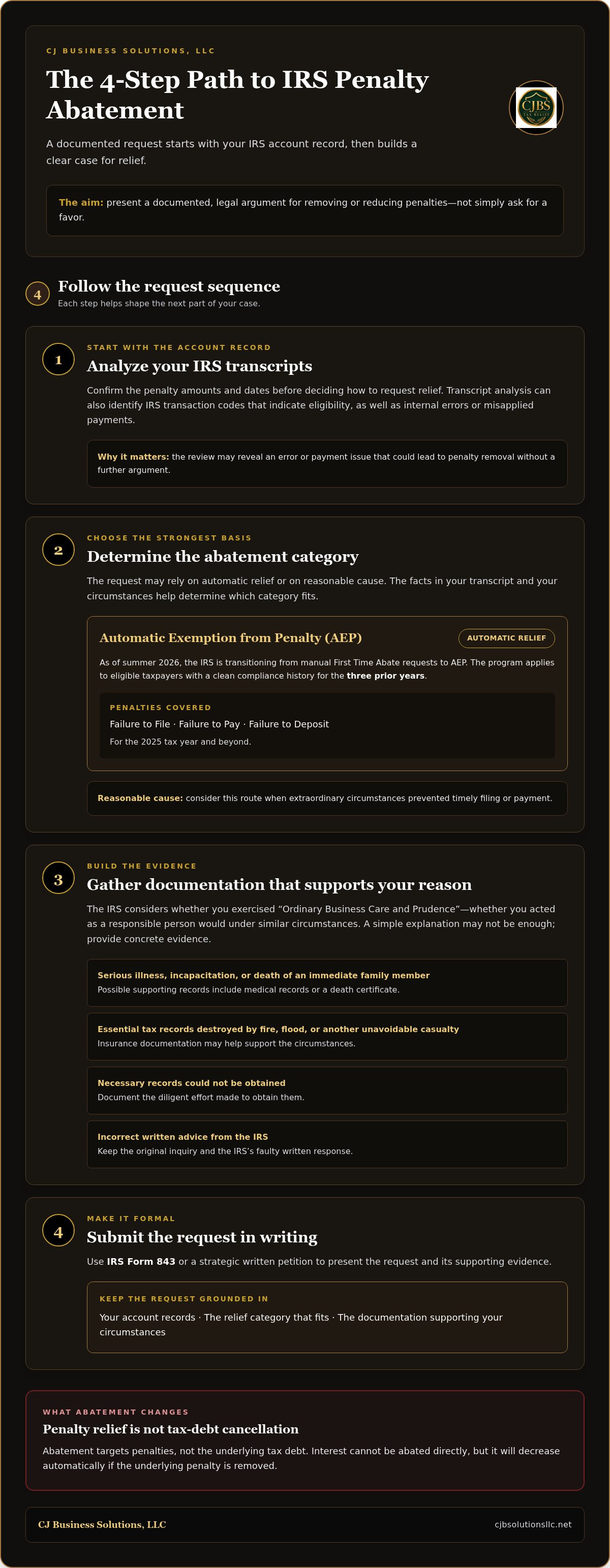
Requesting relief from the IRS requires a methodical and patient approach. It isn't merely about asking for a favor; it's about presenting a documented, legal argument for why your penalties should be removed. When you seek professional tax penalty abatement help, the process typically follows these four essential steps:
- Step 1: Perform a professional transcript analysis to confirm penalty amounts and dates.
- Step 2: Determine the strongest abatement category, such as the new automatic relief or reasonable cause.
- Step 3: Gather supporting documentation, including medical records or insurance claims.
- Step 4: Formalize the request using IRS Form 843 or a strategic written petition.
The Role of Transcript Analysis in Your Strategy
Transcript analysis serves as the foundation of a successful request. By examining your official records, an Enrolled Agent can identify specific IRS transaction codes that signal your eligibility for relief. This deep dive often reveals internal IRS errors or misapplied payments that could lead to an automatic penalty removal without further argument. It's a precise way to ensure your request is based on facts rather than guesswork.
Drafting a Persuasive Abatement Letter
If your situation isn't covered by automatic programs, a written petition is often necessary. This letter must establish a clear timeline of events that align with the IRS guidelines on reasonable cause. The reasonable cause narrative serves as a vital bridge that connects your personal or financial hardship directly to the specific moment of non-compliance. You'll need to demonstrate how you exercised ordinary business care but were still unable to meet your obligations. To ensure your petition is handled with the highest level of expertise, you can learn more about our specialized Transcript analysis services to begin building your case.
Professional Representation and Navigating the IRS Response
After you submit your request, the IRS review period typically spans several weeks or months. During this window, you may continue to receive automated notices that do not yet reflect your pending petition; it's important to remain patient as the agency processes your documentation. If your initial claim is denied, the IRS Appeals process offers a valuable second chance for an independent review. This stage allows a fresh set of eyes to examine your "Reasonable Cause" arguments or your eligibility under new administrative waivers. Successfully navigating these administrative layers often requires the kind of strategic tax penalty abatement help that ensures every legal avenue for relief is thoroughly explored.
Why Work with an Enrolled Agent?
An Enrolled Agent (EA) is a federally authorized practitioner who has demonstrated technical expertise in taxation. Unlike many traditional tax preparers, EAs possess national representation authority and unlimited rights to represent taxpayers before any IRS office. This specialized status is particularly beneficial when handling the complex negotiations required for penalty removal. Having a seasoned mentor manage these direct communications protects you from the stress of the process while ensuring your case is presented with professional poise. This high standard of care helps bridge the gap between complex tax codes and your specific financial situation, prioritizing your long-term trust over a simple transaction.
Maintaining Compliance Post-Resolution
Securing relief is a significant milestone, but the focus must eventually shift toward permanent financial stability and the prevention of future debt. Implementing a steady routine for estimated tax payments can help you avoid the cycle of underpayment penalties that often plagues small business owners. Ongoing accounting services provide the oversight necessary to identify potential issues before they escalate into new IRS notices. By remaining proactive and informed, you can ensure that the peace of mind you've gained remains a lasting part of your financial health. If you are ready to address your current tax concerns with a methodical approach, you can Contact CJ Business Solutions, LLC for a transcript analysis and abatement strategy to begin your journey toward lasting compliance.
Securing Your Financial Future Through Informed Action
Resolving tax debt is a methodical process that begins with understanding your rights and the available relief programs. By utilizing a detailed transcript analysis, you can identify specific errors or eligibility for the new 2026 automatic relief programs that often go unnoticed. Whether you qualify for the Automatic Exemption from Penalty program or need to build a case for reasonable cause, professional tax penalty abatement help ensures your request is handled with precision. Our firm, led by a federally authorized Enrolled Agent with national representation authority, specializes in uncovering these resolution paths to help you regain long-term compliance. You don't have to face the complexities of the IRS alone; instead, you can rely on a steady partner to manage the details on your behalf. We invite you to Request Your Professional Transcript Analysis and Abatement Strategy today. Taking this first step brings you closer to the peace of mind you deserve and a clearer path toward financial stability.
Frequently Asked Questions
Can I get tax penalties removed if I simply can’t afford to pay?
An inability to pay is not typically considered a valid reason for penalty removal on its own. The IRS expects taxpayers to demonstrate that they exercised ordinary business care but still faced circumstances beyond their control. While financial hardship isn't a stand-alone cause, it may support a broader case if it's linked to specific life events like a serious illness or a natural disaster.
How long does the IRS take to process a penalty abatement request?
You can generally expect the IRS to process a written penalty abatement request within 60 to 90 days. However, complex cases or high volume at service centers may extend this timeline to several months. If you are seeking tax penalty abatement help, it's helpful to maintain regular contact with the agency or have a professional monitor your account for any status updates or requests for additional documentation.
Will the IRS remove interest along with my penalties?
The IRS will automatically reduce or remove the portion of interest that was calculated based on the abated penalty. While the interest on the original tax balance remains, any interest accrued specifically on the penalty itself is no longer applicable once that penalty is waived. This adjustment happens systematically, ensuring that your total liability reflects the successful removal of the underlying administrative charges.
What is the First-Time Abate (FTA) policy and do I qualify?
The First-Time Abate policy is an administrative waiver designed for taxpayers who have a clean compliance record for the preceding three years. To qualify, you must have filed all required returns and either paid or arranged to pay any tax currently due. This policy provides a path for those who have been consistently responsible to address an occasional lapse without enduring a significant financial burden.
Is it better to pay the penalty first and then ask for a refund?
Paying the penalty before requesting abatement can be a strategic move because it stops the daily compounding of interest. If your request is later approved, the IRS will issue a refund for the amount paid plus any interest you accrued. However, you aren't required to pay first, and many taxpayers choose to submit their request while the balance is still outstanding to preserve their immediate cash flow.

Article by
Crystal R. Johnson, MBA EA
Crystal Johnson founded CJ Business Solutions to give individuals and small-business owners something often missing from the tax and accounting process: clear explanations, practical solutions, and trusted support.
With more than 27 years of accounting and financial experience, Crystal helps clients understand complicated tax matters, restore compliance, respond to IRS concerns, and make stronger business decisions. As an Enrolled Agent, she is federally authorized to represent taxpayers before the Internal Revenue Service.


