

What if staying tax compliant depended less on last-minute filing and more on a clear process throughout the year? Tax advisory for compliance can help turn recurring responsibilities into a documented routine, making it easier to track deadlines, organize records, and flag questions that need attention. When tax duties overlap or paperwork is incomplete, a consistent review process can help you see what is missing and what to address next.
This guide explains how ongoing advisory can support compliant tax practices and how it differs from preparing a return or resolving an existing tax issue. You’ll learn how to review your records and recurring processes, when tax and accounting support can help maintain accurate reporting, and when transcript analysis or IRS representation may be relevant. With guidance from an Enrolled Agent, you can better identify the type of support suited to your needs and address concerns before they become harder to manage.
Key Takeaways
- Tax advisory for compliance can make recurring tax responsibilities easier to track and review.
- Start by identifying relevant filings, gathering records, and noting recurring processes or unanswered questions.
- Ongoing advisory, return preparation, audit defense, and help with existing tax liabilities address different needs.
- Accurate reporting may call for tax and accounting support, transcript analysis, or IRS representation.
What tax advisory for compliance covers, and what it does not
Tax advisory for compliance is preventive guidance that helps you organize, review, and monitor tax responsibilities before a filing or account issue becomes urgent. For a business, that can mean setting a regular process to track relevant filings, retain supporting records, and raise questions when transactions or reporting practices change. For a foundational overview, Tax compliance describes the broader idea of meeting tax obligations.
In practice, a review might examine how income and expenses are recorded, whether supporting documents are missing, and which transactions need clarification. Advisory does not guarantee that every filing is correct, and it does not replace the work of preparing a return or addressing an existing IRS matter.
How advisory, tax preparation, and IRS representation differ
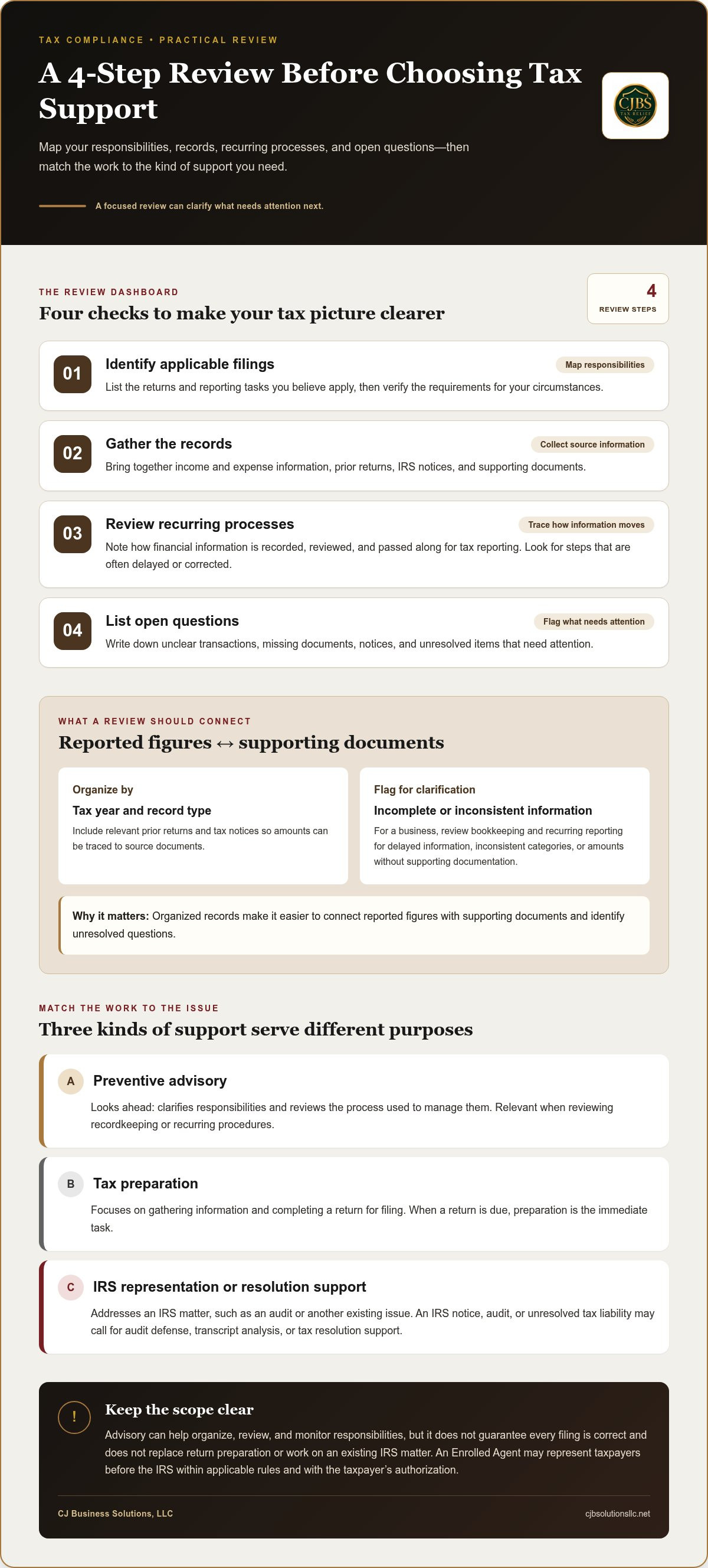
These forms of support serve different purposes. Advisory looks ahead by clarifying responsibilities and reviewing the process used to manage them. Tax preparation focuses on gathering information and completing a return for filing. IRS representation involves communicating or acting on a taxpayer’s behalf in an IRS matter, such as an audit or another existing issue.
Choose support based on the issue in front of you. If you are reviewing recordkeeping or recurring procedures, preventive tax and accounting guidance can help. If a return is due, preparation is the immediate task. If you have an IRS notice, an audit, or an unresolved tax liability, audit defense, transcript analysis, or tax resolution support may be more relevant than routine planning alone.
Representation authority is governed by IRS rules and depends on a professional’s credentials and the taxpayer’s authorization. An Enrolled Agent may represent taxpayers before the IRS within the scope of applicable rules. Understanding the difference between planning, filing, and resolution helps you focus on the work your situation requires.
How to assess your tax compliance needs before choosing support
A focused review can help you decide whether you need preventive guidance, return preparation, or support with an existing concern. Start by mapping your responsibilities and how you currently manage them:
- Identify applicable filings. List the returns and reporting tasks you believe apply, then verify the requirements for your circumstances.
- Gather your records. Collect income and expense information, prior returns, IRS notices, and supporting documents.
- Review recurring processes. Note how financial information is recorded, reviewed, and passed along for tax reporting. Look for steps that are often delayed or corrected.
- List open questions. Write down unclear transactions, missing documents, and notices or unresolved items that need attention.
For individuals, relevant details may include income sources, deductible expenses, and changes that affect reported information. For a business, review bookkeeping consistency and how recurring reporting tasks are handled. Use these as starting points, not a universal checklist, because obligations depend on the taxpayer’s circumstances. The Internal Revenue Service (IRS) provides official guidance, forms, and publications to help verify current requirements.
Which records and processes should a compliance review examine?
Organize records by tax year and type so a reviewer can trace reported amounts to source documents. Include relevant prior returns and tax notices, and flag information that is incomplete or inconsistent. Organized records make a tax review more effective by connecting reported figures with supporting documents and making unresolved questions easier to identify.
For a business, review bookkeeping and recurring reporting processes for delayed information, inconsistent categories, or amounts without supporting documentation. If you need help reviewing your tax and accounting records, tax and accounting support can help clarify what needs attention.
How professional tax advisory can support a more reliable compliance process
A professional review can turn scattered records and unanswered questions into a clearer working process. An advisor can organize tax information, compare source documents with bookkeeping records, and flag items that need clarification before they affect reporting. For example, the review may trace a reported figure to its supporting document or identify where a recurring process produces inconsistent information.
Tax advisory for compliance is most useful when it helps you understand what needs attention and which kind of support fits the issue. Tax and accounting services support accurate records and reporting. If a review raises a question about your IRS account, transcript analysis can help examine relevant tax history. An existing audit or other matter may call for IRS representation or tax resolution support rather than a preventive review alone.
When to seek help with compliance questions or an IRS issue
Consider professional guidance if your records are unclear, the same reporting questions keep coming up, or you cannot readily connect reported figures to their documentation. An IRS notice is another reason to seek help, especially if you are unsure what it concerns or how it relates to your filed returns. Transcript analysis can help identify questions about account history when relevant. The appropriate response to an IRS matter depends on its circumstances and applicable representation rules.
At CJ Business Solutions, LLC, tax and accounting support is led by an Enrolled Agent. The firm provides IRS audit defense, transcript analysis, and tax resolution for situations that call for focused assistance. Start by identifying whether you need to strengthen routine reporting or address an existing concern, then organize the records and questions relevant to that issue.
Make Your Next Tax Review More Intentional
Turn open questions into a short working plan: note what needs clarification, which records are missing, and when you will revisit recurring tax processes. This gives you a practical starting point for deciding whether you need ongoing guidance or focused help with a particular concern. Tax advisory for compliance can help you move from uncertainty to informed decisions without assuming every tax question requires the same response.
CJ Business Solutions, LLC work is led by an Enrolled Agent and includes tax and accounting services, IRS audit defense, transcript analysis, and tax resolution. Explore tax and accounting support from CJ Business Solutions, LLC to take a clear next step toward managing your tax responsibilities.
Frequently Asked Questions
What does a tax compliance advisor do?
A tax compliance advisor helps a taxpayer understand how tax responsibilities connect to day-to-day financial activity. For example, if a business changes how it records a type of income, an advisor can help identify questions to resolve and information needed for accurate reporting. Tax advisory for compliance can also help clarify which issues call for routine planning and which need specialized attention.
Is tax advisory the same as tax preparation?
No. Tax preparation uses financial information to complete a return, while advisory helps address questions that arise before or between filings. For instance, a business might ask how to document a new type of transaction before preparing its next return. The services can complement each other, but preparation alone does not necessarily include ongoing review of business processes or tax questions.
When should a business seek tax compliance advice?
A business may benefit from advice when its financial activity changes, such as when it adds a new revenue source, or when it repeatedly needs to correct records before filing. Guidance can also help when bookkeeping figures do not reconcile or a tax notice raises questions about a return or account. Addressing uncertainty early can clarify what information to gather and what assistance the issue calls for.
Can an Enrolled Agent help with IRS compliance issues?
Yes. An Enrolled Agent may represent taxpayers before the IRS, subject to applicable IRS rules, the agent’s authority, and the taxpayer’s authorization. Depending on the situation, support may involve responding to an audit matter or examining account information through transcript analysis. An Enrolled Agent can help explain the issue and relevant next steps, while the appropriate work depends on the specific circumstances.

Article by
Crystal R. Johnson, MBA EA
Crystal Johnson founded CJ Business Solutions to give individuals and small-business owners something often missing from the tax and accounting process: clear explanations, practical solutions, and trusted support.
With more than 27 years of accounting and financial experience, Crystal helps clients understand complicated tax matters, restore compliance, respond to IRS concerns, and make stronger business decisions. As an Enrolled Agent, she is federally authorized to represent taxpayers before the Internal Revenue Service.


