

What makes a complex tax return challenging is often how its details connect, not simply the number of forms. Business income, investments, rental activity, or a major life change can each affect what belongs on a return. Tax preparation for complex returns means reviewing those connected facts, matching records, and resolving questions before filing. If you are unsure which documents matter or what kind of support you need, start by identifying the income sources and activities involved.
This 2026 guide explains what can make a return more involved, how to assess preparation support, and which records to gather. It also outlines how an Enrolled Agent-led firm such as CJ Business Solutions can organize complicated tax information and address related IRS concerns.
Key Takeaways
- Tax preparation for complex returns involves checking how different income sources and reporting details affect one another, not simply completing additional forms.
- Assess preparation support by looking for relevant experience, careful information gathering, clear explanations, and a review process you can follow.
- Gather financial records and note questions about your business, investments, or personal tax situation before preparation begins.
- CJ Business Solutions is Enrolled Agent-led and reviews connected tax details to prepare returns and identify related issues that may need attention.
What Makes Tax Preparation for Complex Returns Different?
Tax preparation for complex returns is the process of reporting connected financial or business details and checking how each affects the overall return. Rather than entering figures from one wage statement, a preparer may need to compare records from several sources, categorize income and expenses, and resolve differences so the figures are consistent. For general background on tax preparation and U.S. filing considerations, see the Tax Preparation Overview.
Which tax situations commonly call for closer review?
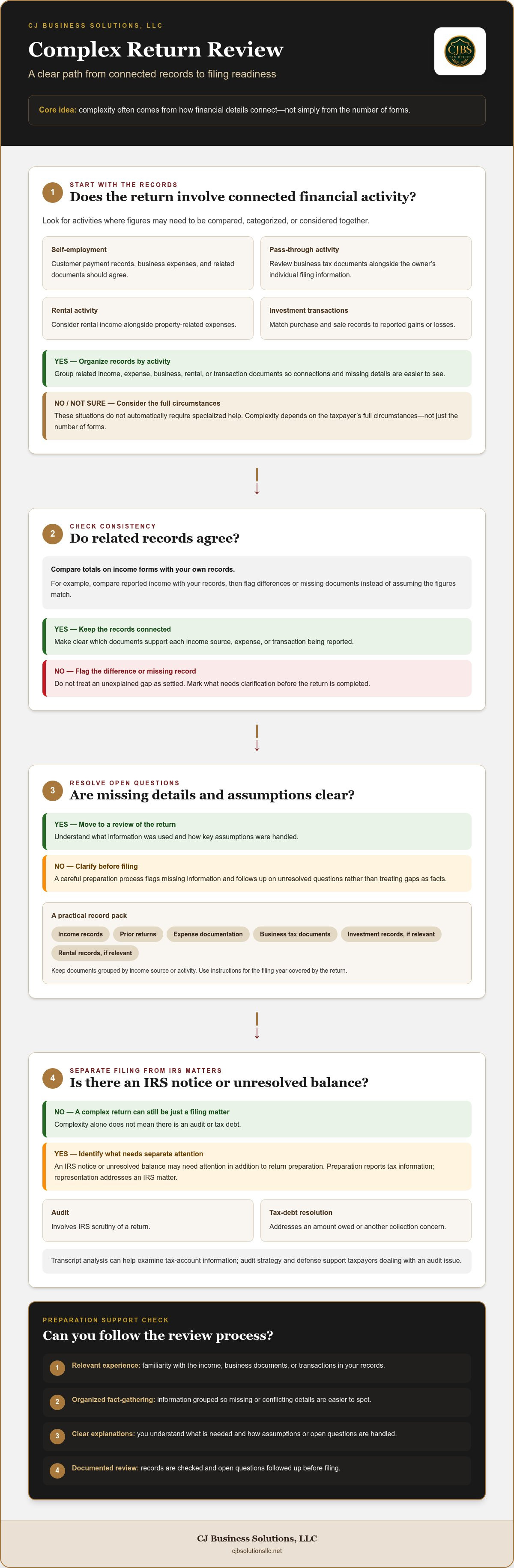
Self-employment income may involve customer payment records, business expenses, and related documents that need to agree. Pass-through business documents can affect an owner’s individual return, while rental activity involves reviewing income alongside property-related expenses. Investment transactions may require matching purchase and sale records to reported gains or losses. For example, compare totals on income forms with your own records, then flag differences or missing documents instead of assuming the figures match. These situations do not automatically require specialized help. The level of complexity depends on the taxpayer’s full circumstances.
- Self-employment: Compare income records with expense documentation and related business details.
- Pass-through activity: Review business tax documents alongside the owner’s individual filing information.
- Rentals and investments: Match activity and transaction records to the income, expense, and gain or loss information being reported.
These reporting questions are not necessarily signs of an IRS audit or tax debt. An audit involves IRS scrutiny of a return; tax-debt resolution addresses an amount owed or another collection concern. A return can be complex even when neither issue is present. An IRS notice or unresolved balance, however, may need attention in addition to return preparation. Start by listing the records that relate to each activity and marking any figures or facts that need clarification.
How to Evaluate Tax Preparation for Complex Returns
Good support should make the preparation process easier to follow, not less transparent. For tax preparation for complex returns, look for a process that considers how business, investment, and personal details may affect one another. Relevant experience matters, but so do thorough questions, understandable explanations, and a review process that shows how the information is being considered.
- Relevant experience: Look for familiarity with the types of income, business documents, or transactions in your records.
- Organized fact-gathering: Information should be grouped in a way that makes missing or conflicting details easier to spot.
- Clear explanations: You should understand what information is needed and how key assumptions or unresolved questions are handled.
- Documented review: A careful process checks records and follows up on open questions before filing.
What should a thorough preparation process include?
Gather income records, prior returns, expense documentation, and relevant business tax documents. Depending on your circumstances, include records for investment or rental activity that help explain the figures being reported. Keep documents grouped by income source or activity. For instance, store business income records with the related expense documents, and keep investment transaction records together. This makes it easier to identify where information belongs and which details need clarification.
A practical checklist: gather the records, connect related details, resolve open questions, and review the return before filing. A preparer should flag missing information and clarify assumptions rather than treating gaps as settled facts. Tax forms and rules depend on the filing year, so use the instructions for the year covered by your return when reviewing filing requirements.
CJ Business Solutions provides tax and accounting support tailored to individual and business needs. Its Enrolled Agent-led team reviews connected tax information as part of return preparation. Explore complex return preparation support.
What to Expect from CJ Business Solutions for a Complex Return
With a complex return, a clear process helps bring different records and tax details into focus. CJ Business Solutions, LLC provides tax preparation and accounting support tailored to individual and business needs, led by an Enrolled Agent. The process starts by understanding your circumstances and available records. From there, information is organized, related details are reviewed together, and the return is prepared based on the facts provided.
This approach keeps attention on the connections within your financial picture. Business documents, personal income, and other tax information can affect different parts of a filing. Reviewing them together can surface questions to resolve before the return is completed. Tax preparation for complex returns does not promise a particular refund or tax result. It is a careful process for reporting relevant information and addressing open questions.
When preparation connects to IRS representation
Preparing a return and representing a taxpayer in an IRS matter are related but distinct services. Preparation focuses on compiling and reporting tax information. If you also have an IRS concern, transcript analysis can help examine tax-account information, while IRS audit strategy defense supports taxpayers dealing with an audit issue. These services address concerns beyond filing, with the appropriate support depending on the issue and the records involved.
If questions about an IRS account arise during preparation, identifying them can clarify what needs separate attention and which records may be relevant. CJ Business Solutions provides tax preparation and related tax resolution and representation services, including transcript analysis and audit defense. Learn about CJ Business Solutions.
Take the Next Step with Greater Clarity
Before beginning, list changes during the tax year, documents you are still gathering, and questions about how one financial activity may affect another. For each income source or business activity, note which records you have and what figures still need explanation. This gives preparation a useful starting point and helps keep the review focused on facts rather than assumptions.
Tax preparation for complex returns is easier to approach when the next step is clear: organize your records, identify what remains uncertain, and choose support that fits your circumstances. CJ Business Solutions is led by an Enrolled Agent and provides tax preparation, transcript analysis, and IRS audit strategy defense for related concerns. Each service addresses a different part of a tax situation.
Discuss your tax preparation needs with CJ Business Solutions to take the next step with an Enrolled Agent-led firm.
Frequently Asked Questions
Is a complex tax return different from a regular tax return?
Yes. A complex return generally requires more coordination among documents and tax details than a return based mainly on straightforward wage income. For example, someone who changes jobs, sells investments, and receives business income may need to match information from several sources. Tax preparation for complex returns focuses on how those details fit together, although the level of complexity depends on the person’s full circumstances.
Can an Enrolled Agent help prepare a complex tax return?
Yes. An Enrolled Agent can help with tax preparation and can represent taxpayers in matters before the IRS. These are distinct kinds of support: preparing a return involves reporting relevant tax information, while representation concerns an IRS matter. At CJ Business Solutions, an Enrolled Agent leads the firm, which provides tax preparation and related IRS support based on the taxpayer’s needs.
What documents should I gather for complex tax preparation?
Start with income records, such as wage statements, payment forms, and investment statements. Add prior-year returns, business income and expense records, and documents for property or other relevant activity. Include IRS notices or correspondence if you have them. Grouping records by income source or activity can make missing documents and questions easier to identify.
What happens if a complex tax return reveals an IRS account issue?
An account concern can be addressed separately from preparing the return. For example, a mismatch between your records and IRS account information may call for transcript analysis to examine what the account reflects. If the issue involves an audit, IRS audit strategy defense may be relevant. The appropriate next step depends on the specific concern and records, and is distinct from filing the return itself.

Article by
Crystal R. Johnson, MBA EA
Crystal Johnson founded CJ Business Solutions to give individuals and small-business owners something often missing from the tax and accounting process: clear explanations, practical solutions, and trusted support.
With more than 27 years of accounting and financial experience, Crystal helps clients understand complicated tax matters, restore compliance, respond to IRS concerns, and make stronger business decisions. As an Enrolled Agent, she is federally authorized to represent taxpayers before the Internal Revenue Service.


