

What if an IRS question about one line on your return led you directly to the record that supports it? That’s the practical goal of Tax record keeping for audits: connecting each figure to clear, retrievable evidence. It’s understandable to be unsure which documents matter, how to organize them, or how long to keep them. A return may draw on records from several sources, and a missing receipt or hard-to-find statement can make a straightforward question more difficult to answer.
This checklist explains which records can support income, deductions, credits, and tax payments, and how to organize them into an evidence trail. You’ll also learn key record-retention time frames and why property and employment tax documents may need separate attention. If an examination becomes complex, an Enrolled Agent’s audit-defense support can help you understand your records and prepare a response.
Key Takeaways
- Tax record keeping for audits works best when each return figure can be traced to clear, retrievable supporting evidence.
- Use a practical checklist to match income, expenses, deductions, credits, and payments with the records that support them.
- Review files regularly for completeness, readability, secure backups, and easy access when questions arise.
- Learn how retention needs can vary and when Enrolled Agent audit-defense support may help with a complex examination.
Tax Record Keeping for Audits Starts with a Clear Evidence Trail
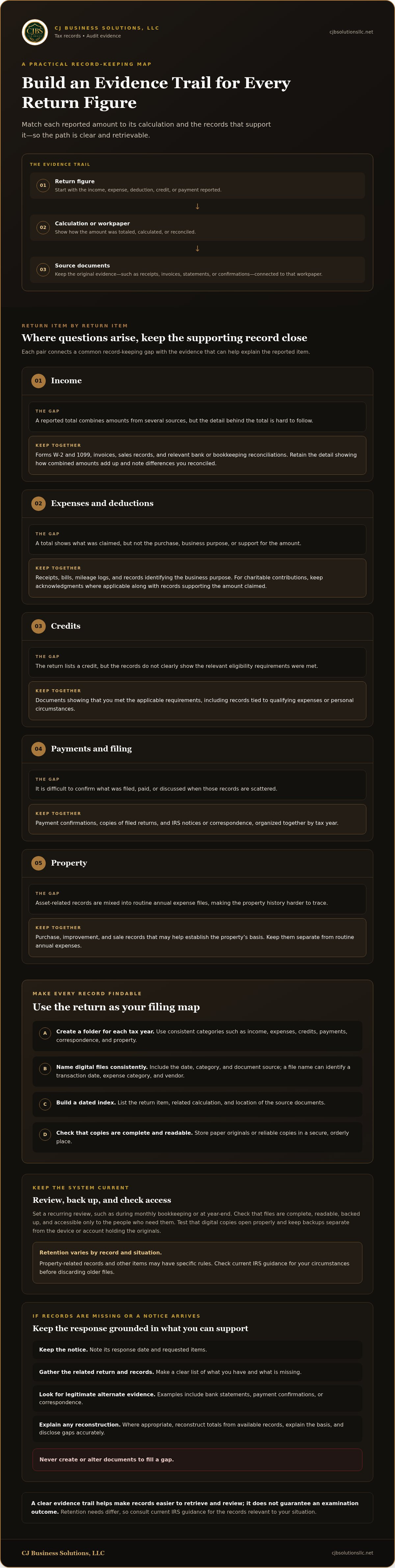
Tax record keeping for audits is more manageable when every important figure on a return connects to evidence you can locate and understand. A tax return summarizes reported income, deductions, credits, and payments; the records behind it show how those amounts were determined. For example, if a business expense total combines receipts from several purchases, keep the receipts together with the workpaper that adds them up and reconciles the total to the return.
An overview of tax audits provides general context, but organizing records around each return item gives you a practical way to prepare for questions. Start with a figure on the return, find the calculation or bookkeeping entry behind it, then trace that calculation to the documents that support it. Label the links between those steps so the path is easy to follow.
What makes a tax document useful during an audit?
A useful record helps explain the transaction, not just the total. Where relevant, look for the amount, date, business purpose, and parties involved. Source documents are the original evidence, such as receipts, invoices, bank statements, or payment confirmations. Workpapers explain how you used that evidence: they may total source documents, show a calculation, or reconcile a ledger to a return figure. Keep both, and note which workpaper or return item each source document supports.
An audit-ready evidence trail links each return figure to the records and calculations that explain how it was reported. This organization can make information easier to retrieve, but it doesn’t guarantee an examination outcome.
Retention needs can vary by transaction and situation, including property-related records and other items with specific rules. Don’t assume one timeframe applies to every document. Check current IRS guidance for the records relevant to your circumstances, and label each file with the tax year and return item it supports.
Use This Tax Record Keeping Checklist to Support Your Return
Use the return itself as your filing map. For each reported amount, collect the records that explain where it came from and how it was calculated. If a total combines several sources, keep the source documents and a reconciliation that shows how they add up. This IRS Recordkeeping for Businesses guidance offers additional context on business records and supporting evidence.
- Income: Keep Forms W-2 and 1099, invoices, sales records, and relevant bank or bookkeeping reconciliations. If a reported total combines several sources, retain the detail showing how they add up and note any differences you reconciled.
- Expenses and deductions: Save receipts, bills, mileage logs, and records identifying the business purpose of an expense. For charitable contributions, retain acknowledgments where applicable, along with records supporting the amount claimed.
- Credits: Keep documents showing that you met the relevant eligibility requirements, such as records tied to qualifying expenses or personal circumstances.
- Payments and filing: Store payment confirmations, copies of filed returns, and IRS notices or correspondence together by tax year. These records help show what was filed, paid, or discussed.
- Property: Preserve purchase, improvement, and sale records that may help establish the property’s basis. Keep these separate from routine annual expenses because they relate to a particular asset.
How should you organize records for quick retrieval?
Create a folder for each tax year, then use consistent categories such as income, expenses, credits, payments, correspondence, and property. Name digital files with the date, category, and document source. For example, a file name can identify the transaction date, expense category, and vendor. Keep complete, readable copies, and store paper originals or reliable copies in a secure, orderly place.
A dated index turns a collection of files into a guide, helping you locate the supporting record for a return item without searching folder by folder. Include the return item, the related calculation, and the location of its source documents. If an examination raises complex questions, organized documents can also support a more informed review with IRS audit-defense support.
Keep Audit Records Accessible and Know When to Get Representation
Good organization is most useful when it stays current. Set a recurring review, such as during monthly bookkeeping or at year-end, to check that files are complete, readable, backed up, and accessible only to the people who need them. Test that digital copies open properly, and keep backups separate from the device or account where the originals are stored. Retention periods can vary by record and situation, so consult current guidance such as IRS Tax Topic 305 - Recordkeeping before discarding older files.
What should you do when records are missing or an IRS notice arrives?
Keep the notice and note its response date and requested items. Gather the relevant filed return and supporting records, then make a clear list of what you have and what is missing. Look for legitimate alternate evidence, such as bank statements, payment confirmations, or correspondence. Where appropriate, reconstruct totals from available records, explain the basis for your calculation, and disclose gaps accurately. Never create or alter documents to fill a hole.
For a complex request, a coordinated response can help keep the records, calculations, and explanations aligned. An Enrolled Agent can review tax records and represent clients in IRS matters. CJ Business Solutions, LLC provides IRS audit-defense support to help you assess documentation and develop a response strategy. Its transcript analysis services can help identify tax issues as part of understanding your tax history.
Tax record keeping for audits is an ongoing practice, not just a task for filing season. A brief, consistent review helps you spot missing documents while there may still be time to retrieve legitimate copies and clarify what each record supports.
Take the Next Step with Greater Clarity
Let your records support informed decisions, not simply remain filed away. Reviewing tax history alongside source documents can help bring attention to issues before you respond to an IRS inquiry. Tax record keeping for audits is an ongoing practice, and a useful next step is to clarify what a notice is asking and how your available evidence relates to it.
CJ Business Solutions, LLC is led by an Enrolled Agent and provides IRS audit strategy defense and tax representation. Its transcript analysis services help identify tax issues as part of understanding your tax history. For guidance with a complex examination, learn how CJ Business Solutions, LLC can help with IRS audit representation.
A thoughtful review can make a difficult process feel more manageable. Take it one question, one record, and one well-considered step at a time.
Frequently Asked Questions
How long should I keep tax records in case of an IRS audit?
Keep most tax records for at least three years after filing, but certain situations call for longer retention. The period can extend to six years when more than 25% of gross income is omitted, and there’s no limit for a fraudulent return or a return that wasn’t filed. Keep property records while you own the property and for three years after disposal; employment tax records for at least four years.
Are digital copies of tax records acceptable for an IRS audit?
Yes, digital records can be useful if they’re accurate, complete, readable, and available when requested. Scan both sides of documents when relevant, preserve attachments and transaction details, and use backups to reduce the risk of losing files. Before relying on a digital copy, make sure it opens clearly and shows the information an original would, such as the date, vendor, and amount.
What should I do if I cannot find a document requested during an audit?
Don’t create a replacement or alter another record. Check the notice for the response date, then look for legitimate duplicates, such as a vendor invoice, bank or credit card statement, or an email confirmation. Record what you searched for and what you found. If you estimate or reconstruct information from reliable records, explain the method and identify any remaining gap accurately.
Are bank statements enough to prove a business expense?
A bank statement can show that money left your account, but it may not establish what you bought or why the expense was business-related. Pair it with an itemized receipt, invoice, or other documentation that identifies the purchase and its business purpose. For example, a card charge at an office-supply store may need an itemized receipt to show which supplies were purchased.

Article by
Crystal R. Johnson, MBA EA
Crystal Johnson founded CJ Business Solutions to give individuals and small-business owners something often missing from the tax and accounting process: clear explanations, practical solutions, and trusted support.
With more than 27 years of accounting and financial experience, Crystal helps clients understand complicated tax matters, restore compliance, respond to IRS concerns, and make stronger business decisions. As an Enrolled Agent, she is federally authorized to represent taxpayers before the Internal Revenue Service.


