

What if the aggressive collection notices arriving in your mail were actually the catalyst for a fresh financial start rather than a source of constant anxiety? It's completely natural to feel overwhelmed when facing the complexity of federal tax codes, especially when the threat of wage garnishments or bank levies hangs over your daily life. You aren't alone in wanting a clear, honest path forward that doesn't involve constant fear. Many taxpayers find that professional tax debt negotiation services provide the necessary bridge between their current hardship and a sustainable resolution.
We understand that your goal is simply to find a solution that respects your financial reality. This guide explores how you can work toward a reduced total debt amount through an Offer in Compromise or establish a monthly payment plan that actually fits your budget. We'll walk through the methodical steps of transcript analysis and professional representation to help you regain your peace of mind and resolve your federal liabilities with confidence. By understanding the options available to you, you can move from a place of uncertainty to a position of stability and long-term relief.
Key Takeaways
- Understand that tax debt negotiation is a formal, structured process where the IRS seeks a practical resolution rather than indefinite collection actions.
- Learn why selecting professional tax debt negotiation services led by qualified experts ensures your case is handled with the necessary transparency and care.
- Discover how a methodical transcript analysis serves as the essential first step to uncovering potential errors and identifying your best path toward resolution.
- Gain insights into maintaining long-term financial health by adjusting your tax withholdings and staying compliant after your debt is successfully resolved.
Understanding Tax Debt Negotiation: How to Resolve Federal Liabilities
Tax debt negotiation is a formal process of reaching a structured agreement with the IRS to resolve outstanding liabilities. It's helpful to view tax debt negotiation as a legal right for taxpayers who are facing genuine financial hardship or who believe their liabilities are incorrect. Professional tax debt negotiation services help facilitate this dialogue, ensuring that the resolution is both sustainable for the taxpayer and acceptable to the government. The IRS offers these programs because they recognize that collecting a portion of the debt through a settled agreement is often more efficient than maintaining indefinite collection actions that may never yield results. Through this process, you may be able to reduce your total balance, stop the accumulation of interest and penalties, or restructure your payments into a manageable monthly plan.
Why the IRS Settles: The Concept of Reasonable Collection Potential
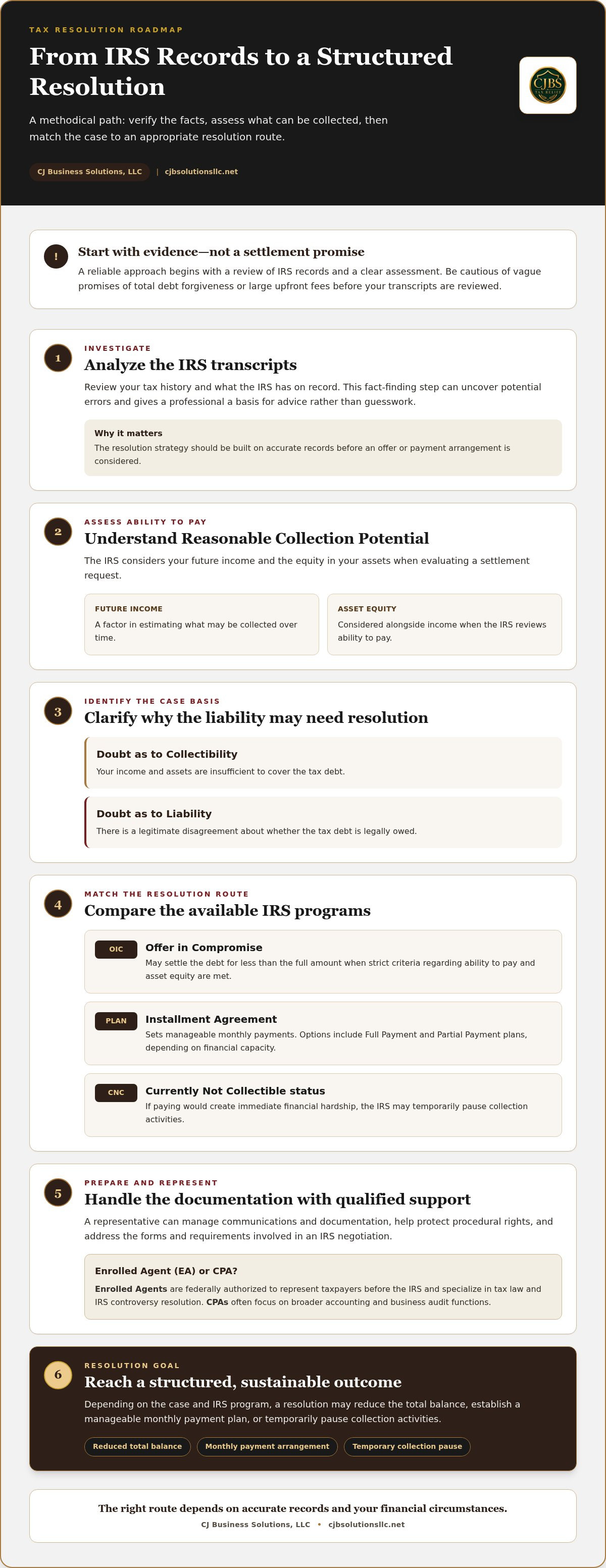
When evaluating a settlement request, the IRS focuses on a metric known as Reasonable Collection Potential (RCP). This calculation accounts for your future income and the equity you hold in your assets. If the IRS determines that you truly cannot pay the full amount within the remaining time they have to collect, they may agree to a settlement. Most negotiations fall into two categories. Doubt as to Collectibility applies when your assets and income are insufficient to cover the debt. Doubt as to Liability occurs when there is a legitimate disagreement regarding whether the tax debt is legally owed in the first place.
The Risks of Going It Alone vs. Professional Representation
Attempting to communicate directly with IRS revenue officers can be a daunting experience. Many taxpayers inadvertently share information that can lead to more aggressive collection tactics or miss out on procedural protections they didn't know existed. A professional representative, such as an Enrolled Agent, acts as a necessary buffer between you and the IRS. They ensure your rights remain protected while managing the complex flow of documentation. This methodical approach helps lower the stress of the situation, allowing you to focus on your daily life while an expert handles the technical details of your resolution.
Choosing the Right Tax Debt Negotiation Service: Options and Professionals
Selecting a partner to assist with your federal tax issues is a significant decision. You'll find that tax debt negotiation services vary greatly in their approach and professional qualifications. It's essential to look for a firm that prioritizes transparency and provides a thorough initial assessment of your situation. A reliable guide will offer a clear, step-by-step roadmap tailored to your specific needs. This methodical approach avoids the vague promises of total debt forgiveness that are often found in aggressive marketing. Credentials matter. You deserve a representative who understands the nuances of the tax code and has the authority to speak on your behalf.
Enrolled Agents vs. CPAs: Who Should Represent You?
While many professionals work within the tax field, their areas of expertise differ. Enrolled Agents (EAs) are federally authorized by the U.S. Department of the Treasury to represent taxpayers before the IRS. Unlike CPAs, who often focus on broad accounting and audit functions for businesses, EAs specialize specifically in tax law and IRS controversy resolution. This specialized focus makes an Enrolled Agent a steady partner when you're facing complex collection issues. They're trained to handle the specific forms and procedural requirements that the IRS demands during a negotiation.
Common IRS Resolution Programs Compared
Understanding the available programs helps you engage in the process with confidence. A professional service should help you evaluate which of these options fits your financial reality:
- Offer in Compromise (OIC): This program allows you to settle your debt for less than the full amount if you meet strict criteria regarding your ability to pay and asset equity.
- Installment Agreements: These plans allow for manageable monthly payments. They range from Full Payment plans to Partial Payment plans, depending on your financial capacity.
- Currently Not Collectible (CNC) status: If paying your tax debt would create an immediate financial hardship, the IRS may temporarily pause collection activities.
A methodical professional will always start with a deep-dive into your records to understand exactly what the IRS sees. This ensures that the advice you receive is based on facts rather than guesswork. If you're looking for a firm that values this level of precision, exploring Tax Resolution Services can help you understand the specific steps needed for your case. Avoiding firms that demand large upfront fees without first reviewing your specific IRS transcripts is a vital step in protecting your financial interests.
The Negotiation Roadmap: From Transcript Analysis to IRS Approval
A successful resolution doesn't begin with a settlement offer; it starts with a methodical investigation of your tax history. Professional tax debt negotiation services prioritize this investigative phase to ensure that your strategy is built on accurate data rather than assumptions. This journey involves several distinct stages, each requiring a high level of precision and patience. By following a structured roadmap, you can move toward an agreement that is both sustainable and legally sound.
Transcript analysis can reveal the 'Statute of Limitations' on certain tax years, potentially eliminating debt without the need for an Offer in Compromise. This initial deep-dive is the most effective way to identify errors or missed credits that could significantly lower your balance before formal negotiations even begin.
The Power of IRS Transcript Analysis
Decoding your tax history allows a representative to identify the exact root of your debt. One of the most valuable insights gained during this process is identifying the Collection Statute Expiration Dates, often referred to as CSEDs. These dates determine how much time the IRS has left to legally collect on a specific tax year. Understanding these timelines helps you decide whether it's better to settle the debt or simply allow the collection period to expire through a strategy of maintained compliance.
Substantiating Financial Hardship
Gathering the documentation needed to prove your financial reality is often the most labor-intensive part of the process. This typically involves preparing Form 433-A for individuals or Form 433-B for businesses with meticulous detail. It's vital to match your reported living expenses to the IRS National Standards for housing, transportation, and food. Discrepancies here can lead to a rejection of your proposal, making professional oversight essential for a successful outcome.
Negotiation often involves multiple rounds of correspondence and potential appeals if the initial offer is not accepted. If you're ready to uncover the specific facts within your tax records, you can begin with specialized Transcript analysis services to identify your most reliable path to resolution.
Securing Your Financial Future with Expert Tax Representation
Achieving a formal resolution with the IRS is a significant milestone, yet it represents only the first half of a complete financial recovery. Maintaining long-term compliance is essential to prevent the accumulation of future debt. The calm, methodical approach of an Enrolled Agent is designed to reduce the emotional burden often associated with tax controversy. This professional partnership allows you to focus on your personal and professional life while your representative manages the technical requirements of federal tax challenges. CJ Business Solutions, LLC provides the steady guidance needed to handle these complex situations with quiet confidence.
Maintaining Compliance After Resolution
If you've successfully secured an Offer in Compromise, you must adhere to the five-year compliance rule. This requirement means you must file all tax returns and pay all taxes on time for the next five years. Failure to do so can result in the IRS rescinding your settlement and reinstating the original debt amount. Professional accounting services help prevent this 'revolving door' of tax debt by establishing reliable systems for your future filings. Your representative will help you adjust your withholdings or calculate accurate estimated payments to ensure you never find yourself back in a cycle of liability.
Taking the First Step Toward Peace of Mind
Resolving tax issues is a marathon, not a sprint. It requires a partner who values substance over flash and prioritizes your long-term success. We invite you to consider a quiet, professional consultation to assess your unique situation. This initial conversation is a resource-sharing opportunity where you can learn about your options without feeling rushed or pressured. By choosing professional tax debt negotiation services, you're investing in a future free from the anxiety of collection notices. Discover how our Enrolled Agent can help you resolve your tax debt and find a sustainable path forward.
Restoring Stability Through Methodical Tax Resolution
Finding a sustainable path through federal tax challenges requires a shift from reactive stress to proactive strategy. The foundation of a successful outcome lies in specialized transcript decoding and analysis, which uncovers the specific facts of your tax history. By working with an IRS Enrolled Agent, you gain national representation and expertise in IRS audit strategy defense, ensuring your rights are protected throughout every round of correspondence. This methodical approach doesn't just resolve past liabilities; it establishes the systems necessary for your future financial health.
You don't have to manage these complex negotiations alone. Professional tax debt negotiation services offer a steady, reliable partnership that prioritizes your autonomy and peace of mind. When you're ready to move beyond the anxiety of collection notices, the first step is gaining a clear understanding of your current standing with the IRS. We invite you to schedule a professional transcript analysis with our Enrolled Agent to begin your journey toward resolution. With the right guidance, a fresh start is entirely within reach.
Frequently Asked Questions
How much does it cost to hire a tax debt negotiation service?
Professional fees for tax debt negotiation services are typically determined by the complexity of your specific case and the depth of the resolution required. Most reputable firms provide a clear outline of their fee structure after an initial review of your IRS transcripts and financial situation. It's helpful to view these costs as an investment in expert representation that aims to secure a sustainable and legally sound outcome for your federal liabilities.
Can I negotiate with the IRS on my own without a professional?
You have the legal right to communicate directly with the IRS and represent yourself throughout the negotiation process. While this is possible, many taxpayers find the technical requirements and complex tax codes quite difficult to manage without assistance. Engaging a seasoned mentor to act as your representative provides a steady buffer, ensuring that all documentation is filed correctly and your procedural rights remain protected.
How long does the tax debt negotiation process typically take?
The duration of the process depends on the specific resolution path you pursue and the current workload at the IRS. A standard installment agreement might be established in a few weeks, whereas an Offer in Compromise often requires several months of review and correspondence. A methodical representative will provide you with regular updates as your case progresses through the various stages of IRS evaluation.
What is the success rate of an Offer in Compromise?
Success rates for settlement offers vary annually and depend heavily on how accurately a taxpayer's financial reality is presented to the IRS. The IRS evaluates each proposal based on its internal calculations of your future income and asset equity. Ensuring that your application is supported by a thorough transcript analysis and precise financial documentation is the most effective way to improve the likelihood of a favorable determination.
Will negotiating my tax debt stop a wage garnishment or bank levy?
Entering into a formal negotiation process often provides an immediate pause on aggressive collection actions like wage garnishments or bank levies. When you submit a valid request for a resolution program, the IRS generally suspends most collection activities while they review your proposal. This allows you to work toward a permanent solution with a sense of stability and reduces the immediate pressure on your daily finances.

Article by
Crystal R. Johnson, MBA EA
Crystal Johnson founded CJ Business Solutions to give individuals and small-business owners something often missing from the tax and accounting process: clear explanations, practical solutions, and trusted support.
With more than 27 years of accounting and financial experience, Crystal helps clients understand complicated tax matters, restore compliance, respond to IRS concerns, and make stronger business decisions. As an Enrolled Agent, she is federally authorized to represent taxpayers before the Internal Revenue Service.


