

What if the most effective way to manage a mounting IRS debt was not a frantic negotiation, but a quiet, data-driven defense? For many entrepreneurs, the arrival of contradictory tax notices or the threat of an audit creates a level of stress that can easily cloud professional judgment. You likely feel that your business’s financial future is at risk, especially with the IRS interest rate for underpayments currently at 7% for the third quarter of 2026. It is understandable to fear that a single bank levy or asset seizure could disrupt the stability you have worked so hard to establish.
This article introduces a methodical approach to tax resolution for small business that prioritizes long-term stability over temporary fixes. We will share how a disciplined strategy can help you secure a clear path to compliance and work toward a reduction of penalties through professional representation. By focusing on detailed transcript analysis and a structured recovery roadmap, you can protect your assets and return your focus to the daily operations of your company. You will learn how to replace confusion with a composed, professional plan for financial recovery that allows you to engage with the IRS from a position of quiet confidence.
Key Takeaways
- Identify the common operational catalysts, such as payroll discrepancies and compliance gaps, that frequently lead to complex IRS disputes for modern entrepreneurs.
- Understand the fundamental role of IRS transcript analysis in decoding internal records to identify misapplied payments or administrative errors.
- Evaluate various recovery paths to determine if your company qualifies for specialized programs like an Offer in Compromise.
- Learn how the federal authority of an Enrolled Agent provides a distinct advantage when seeking tax resolution for small business and managing audit defense.
- Gain a clear, methodical framework for transitioning from the stress of tax debt toward long-term financial stability and regulatory compliance.
Navigating the Complexities of Small Business Tax Liabilities
The experience of managing a growing enterprise is often met with unforeseen administrative burdens that can feel overwhelming. As we move through 2026, the regulatory environment has become increasingly precise. With the IRS interest rate for underpayments currently at 7% for the third quarter, even a minor oversight in documentation can quickly compound into a significant financial obligation. When a business owner encounters these challenges, the initial response is often one of high stress, particularly when faced with the potential for asset seizures or bank levies. It's natural to feel concerned about the stability of your company's future when the path forward seems obscured by complex notices.
The emotional and financial toll of unresolved federal debt extends beyond the balance sheet. It often impacts daily operations, making it difficult to focus on growth or employee retention. While the urge to engage in reactive, panic-driven filing is strong, such actions often lead to further errors. A methodical approach to tax resolution for small business is far superior, as it allows for a calm assessment of the facts before any communication is sent to the IRS. By choosing a steady path, you ensure that your business's dignity and financial health remain intact during the recovery process.
Common Tax Hurdles for Modern Entrepreneurs
Many disputes begin with simple catalysts, such as errors in payroll reporting or gaps in quarterly compliance. For example, missing the filing deadline for Form 941 can trigger immediate penalties that escalate each month. The IRS often evaluates these discrepancies through the lens of tax morale, which reflects a taxpayer's perceived commitment to the tax code. While a single error might be viewed as an oversight, a pattern of missed filings suggests a lack of internal controls that may invite closer scrutiny. Understanding these hurdles is the first step toward building a more resilient compliance structure.
The Shift from Compliance to Resolution
True recovery requires a transition from simply reacting to notices to adopting a comprehensive resolution strategy. Rather than viewing tax debt as a crisis to be silenced, you can treat it as a structural issue that requires a steady, professional partnership. This shift allows for a more transparent look at the company's financial health and encourages a logical progression toward a settlement. Establishing this partnership early helps you move away from the cycle of fear and into a proactive state of tax resolution for small business. This composed methodology ensures you aren't just filing forms, but are actively protecting your business’s longevity.
The Critical Role of IRS Transcript Analysis in Tax Resolution
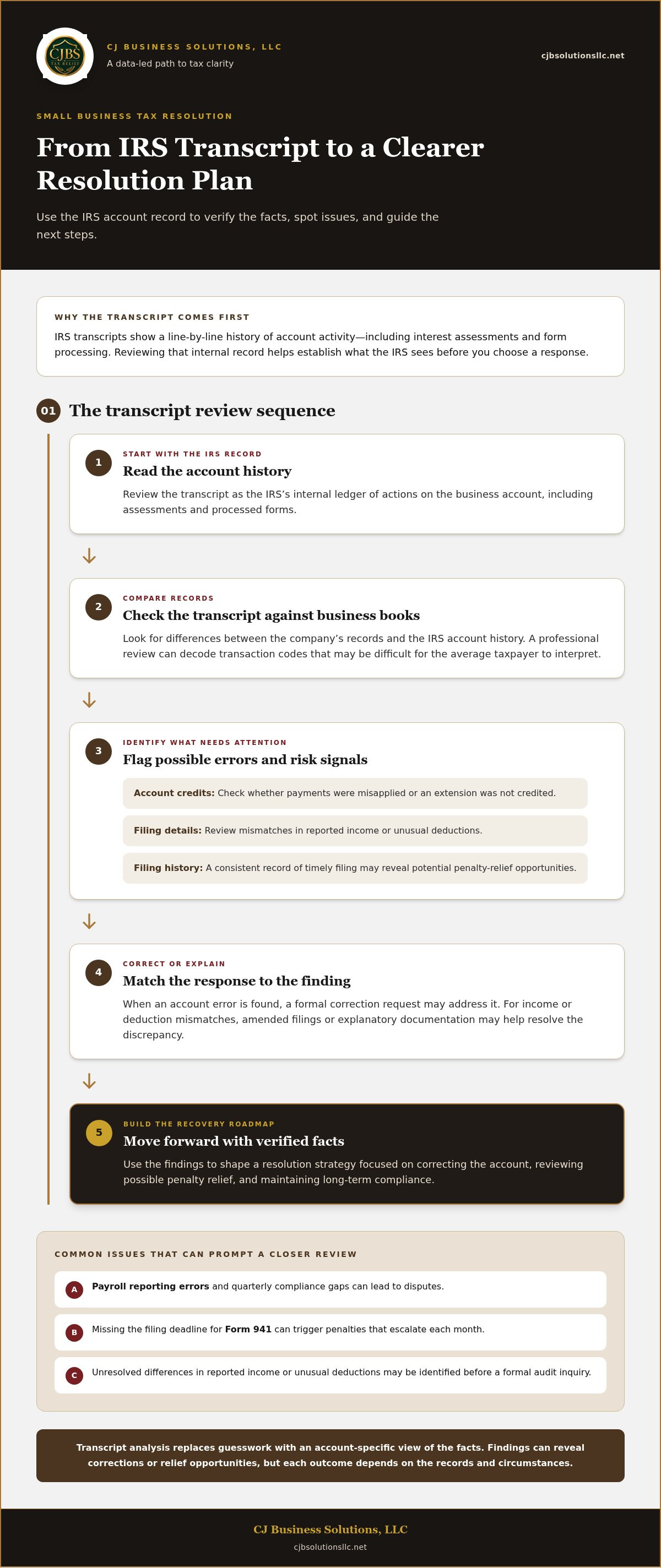
Success in tax resolution for small business rarely depends on a persuasive argument alone. Instead, it relies on an objective understanding of the data the IRS holds in its internal systems. These records, known as transcripts, provide a line-by-line history of every action taken on your account, from the assessment of interest to the processing of specific forms. IRS transcript analysis is a diagnostic tool for tax health that allows a professional to view the internal ledger of your business account exactly as the government sees it. This transparency is the essential foundation of any strategic tax defense.
Decoding these internal records often reveals that the IRS has misapplied payments or failed to credit an extension. When these errors are identified, they can be corrected through a formal request, which often results in an immediate reduction of the total balance owed. Expert analysts look for these elusive solutions by reviewing transaction codes that are often incomprehensible to the average taxpayer. This data-driven approach replaces the stress of the unknown with a clear, factual summary of your standing, allowing you to move forward with quiet confidence.
Using Data to Identify Hidden Tax Issues
A common challenge for entrepreneurs is the discrepancy between their internal books and the IRS's records. A historical review of your transcripts can uncover opportunities for penalty abatement that you might have otherwise missed. For instance, if your business has a consistent history of timely filing, you may qualify for specific relief programs that are only visible through a deep data review. If you're seeking this level of clarity, exploring professional transcript analysis services can be an excellent first step in your recovery roadmap.
Transcript Analysis as a Preventative Audit Step
Proactive reviews serve as a vital warning system by flagging potential audit triggers before the IRS initiates a formal inquiry. By identifying mismatches in reported income or unusual deductions early, you can address these issues through amended filings or explanatory documentation. The value of a professional decoding service lies in its ability to translate complex federal records into a steady, actionable plan. This preventative measure ensures that your strategy for tax resolution for small business remains focused on long-term stability and compliance.
Comparing Strategic Resolution Options for Your Business
Once the transcript analysis has provided a clear view of the facts, the next step in tax resolution for small business is to evaluate the most appropriate recovery path. This selection is a deliberate process that considers your current cash flow and long-term goals. It is helpful to define transcript analysis as a diagnostic tool for tax health that allows you to select the most effective remedy for your specific situation. By choosing a path based on data rather than urgency, you ensure the chosen strategy is both sustainable and effective.
For many, an Installment Agreement offers a predictable way to settle debt while maintaining business operations. While the standard failure-to-pay penalty is 0.5% per month, this rate typically drops to 0.25% once an agreement is in effect. This reduction, combined with daily compounded interest at the current 7% rate for the third quarter of 2026, makes a structured plan a logical choice for preserving liquidity. These agreements are designed to be steady and manageable, providing a sense of stability during the recovery period.
Penalty Abatement remains a significant resource for those seeking tax resolution for small business. Starting in the summer of 2026, the IRS is launching the Automatic Exemption from Penalty (AEP) program to provide first-time relief for eligible businesses without a formal request. For those who don't qualify for automatic relief, a professional can still negotiate the removal of failure-to-file charges based on reasonable cause.
The Offer in Compromise (OIC) Framework
The Offer in Compromise is often misunderstood as a simple settlement for a fraction of the debt. In reality, it's a rigorous framework where the IRS agrees to accept less than the full amount only when a taxpayer's inability to pay is clearly documented. The $205 application fee is part of a process that requires meticulous financial disclosure. Professional representation ensures that your application is based on a realistic assessment of your reasonable collection potential, which improves the likelihood of acceptance.
Defending Against IRS Collections
When federal tax liens or wage garnishments are in place, the priority shifts to collection defense. These actions can severely disrupt a company's ability to pay vendors or meet payroll. Strategic defense involves negotiating the release of these levies by demonstrating that they create an immediate economic hardship. This intervention is crucial for maintaining business operations while the final resolution is being finalized.
If you're ready to explore these options with a seasoned mentor, you can learn more about our tax resolution services to find the path that best suits your needs.
The Advantage of Professional Representation by an Enrolled Agent
Choosing the right professional is as critical as the resolution strategy itself. While many business owners rely on standard accountants for annual filing, an Enrolled Agent (EA) provides a distinct level of expertise in tax resolution for small business. Enrolled Agents are federally licensed tax practitioners who have earned unlimited practice rights before the IRS. This status, granted by the U.S. Department of the Treasury, allows them to represent any taxpayer on any tax matter before any IRS office. This level of authority is shared only by CPAs and tax attorneys, making an EA a formidable ally in complex disputes.
The primary difference between a generalist and an EA lies in their specialized focus on tax law and representation. While a standard accountant might record historical data, an EA actively develops an IRS audit strategy defense designed to protect your specific business interests. This proactive approach ensures that every response to the IRS is grounded in federal tax code and backed by the detailed transcript analysis discussed earlier. By engaging an expert, you gain a partner who understands the nuances of the 2026 regulatory changes and the specific procedural requirements of the federal government.
Expert Representation in Audits and Appeals
During a formal examination, an Enrolled Agent acts as your Seasoned Mentor, providing a steady hand during a high-stakes process. One of the most significant benefits of this partnership is the professional buffer it creates. You are not required to attend the audit in person when you have authorized representation. Your EA handles all direct communication and documentation requests, which prevents the accidental disclosure of unnecessary information. This disciplined methodology lowers your personal stress and ensures the investigation remains focused on the relevant facts.
Securing Your Business’s Financial Future
The ultimate goal of any recovery roadmap is to transition from crisis management to a state of permanent financial stability. Once your current debt is resolved, your EA helps you build a structure for ongoing compliance to prevent future audits. This includes establishing better internal controls for payroll and estimated tax payments. We invite you to explore professional tax resolution services for a calm, methodical consultation. Working with a steady, reliable partner allows you to navigate federal tax laws with confidence, ensuring your business remains a healthy and compliant entity for years to come.
Establishing a Foundation for Long-Term Compliance
Resolving federal tax debt is a methodical journey that begins with understanding the facts behind the numbers. By utilizing transcript analysis to identify misapplied payments and exploring structured resolution options, you can replace uncertainty with a clear, data-driven plan. This strategic approach to tax resolution for small business ensures that your recovery is sustainable and protects the assets you've worked hard to build. Moving forward with a logical progression allows you to address immediate concerns while securing the future of your company.
When you're ready to transition from crisis to stability, having a seasoned mentor makes a significant difference. CJ Business Solutions, LLC offers expert IRS representation led by an Enrolled Agent who utilizes specialized transcript analysis to uncover errors and develop a strategic defense for federal tax examinations. You don't have to navigate these complex regulations alone. We invite you to Request a Professional Consultation with CJ Business Solutions, LLC to begin your methodical recovery. Your business deserves a future defined by growth rather than the stress of tax disputes. With the right guidance and a steady plan, you can achieve lasting peace of mind.
Frequently Asked Questions
What is the first step in resolving small business tax debt?
The first step in a methodical recovery is obtaining a clear, factual understanding of your current standing through a review of your IRS transcripts. This diagnostic phase allows you to see exactly what the government has recorded, including any misapplied payments or missing filings. By starting with data, you can build a strategy for tax resolution for small business that's based on facts rather than assumptions or fear.
Can an Enrolled Agent represent my business in an IRS audit?
Yes, an Enrolled Agent has the federal authorization to represent your business in an IRS audit or any other tax matter. Unlike standard accountants, Enrolled Agents are licensed by the U.S. Department of the Treasury specifically to act on behalf of taxpayers before all administrative levels of the IRS. This representation provides a professional buffer, allowing the expert to handle all direct communication and documentation requests while you focus on your daily operations.
How does transcript analysis help reduce the amount I owe the IRS?
Transcript analysis helps reduce your balance by uncovering administrative errors, such as payments that weren't properly credited to your business account. It also allows a professional to identify specific transaction codes that indicate eligibility for penalty abatement programs. By decoding these complex records, you can often find legitimate ways to lower the total amount owed through factual corrections and historical data review.
Is it possible to settle business tax debt for less than the full amount?
It's possible to settle for less than the full amount through a program known as an Offer in Compromise, provided your business meets strict eligibility criteria. The IRS evaluates these requests based on your reasonable collection potential, which includes an analysis of your assets and future income. While it's a valuable tool for tax resolution for small business, it requires meticulous documentation and a realistic assessment of your financial situation to be successful.
What happens if my small business cannot pay its federal taxes on time?
If your business cannot pay on time, the IRS will begin assessing failure-to-pay penalties and daily compounded interest. As of the third quarter of 2026, the underpayment interest rate stands at 7%. Over time, unresolved debt can lead to more severe collection actions, such as federal tax liens or bank levies. However, establishing an installment agreement or seeking penalty relief early can help stabilize the situation and prevent these aggressive measures from being taken.

Article by
Crystal R. Johnson, MBA EA
Crystal Johnson founded CJ Business Solutions to give individuals and small-business owners something often missing from the tax and accounting process: clear explanations, practical solutions, and trusted support.
With more than 27 years of accounting and financial experience, Crystal helps clients understand complicated tax matters, restore compliance, respond to IRS concerns, and make stronger business decisions. As an Enrolled Agent, she is federally authorized to represent taxpayers before the Internal Revenue Service.


